19 plates at 3840×2160 · $8
Grain that knows where to stop
Film grain is strongest in the midtones and vanishes in the blacks and the blown highlights. These are still plates — they cannot know what is underneath them. The Overlay blend mode supplies that for them, and the maths is below.
Where the grain goes, and where it does not
Overlay is
out = 2·L·p below mid grey and
out = 1 − 2(1−L)(1−p) above it. Differentiate with
respect to the plate value p and you get
2·min(L, 1−L): full strength at mid grey, nothing at pure
black and pure white. No mask, no keyframe.
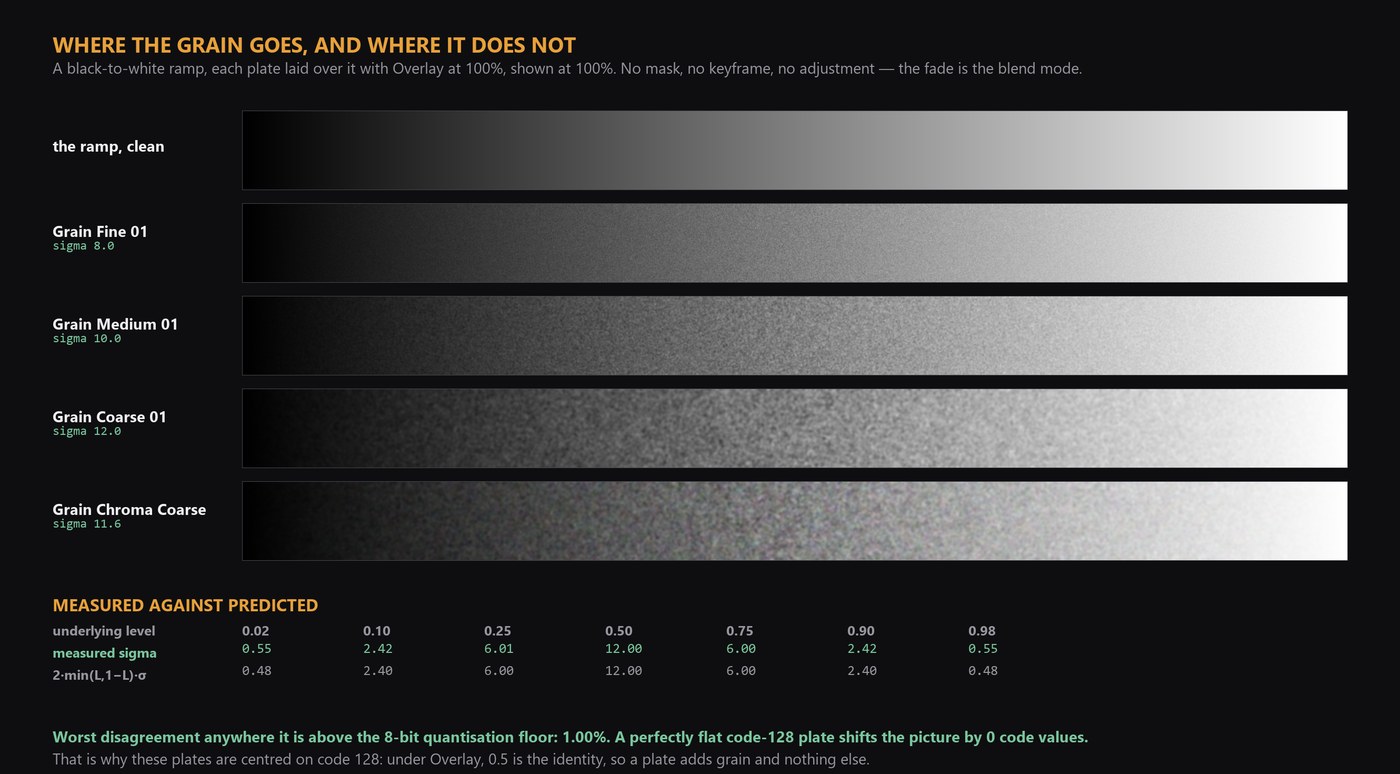
The grain plates at 100%
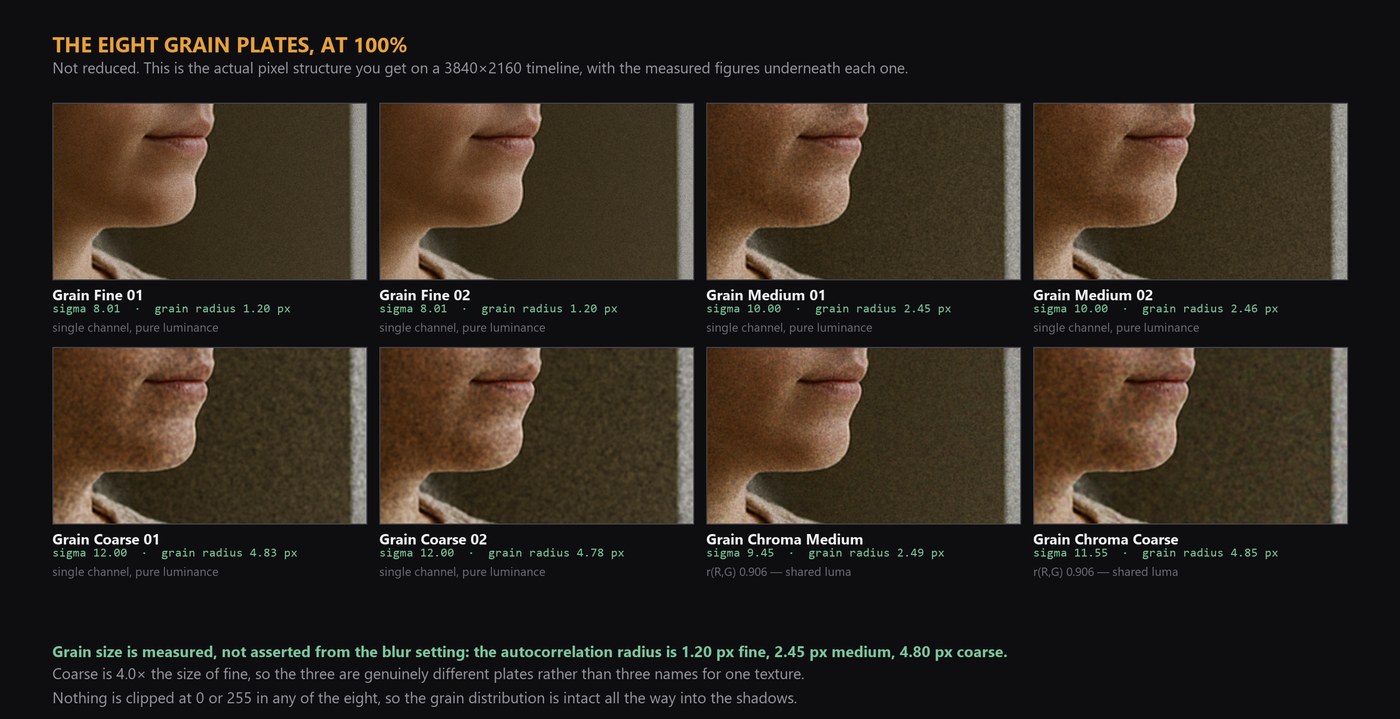
Grain Fine 01
35mm-scale grain. Reads as texture rather than as noise; survives compression better than the coarse plates do. Measured sigma 8.01, grain radius 1.20 px, single channel, pure luminance. Both crops below are cut at this page's own width and never resized, so you are looking at the real pixels.


Grain Fine 02
35mm-scale grain. Reads as texture rather than as noise; survives compression better than the coarse plates do. Measured sigma 8.01, grain radius 1.20 px, single channel, pure luminance. Both crops below are cut at this page's own width and never resized, so you are looking at the real pixels.

Grain Medium 01
The default. Clearly visible at 100% without taking over the picture. Measured sigma 10.00, grain radius 2.45 px, single channel, pure luminance. Both crops below are cut at this page's own width and never resized, so you are looking at the real pixels.

Grain Medium 02
The default. Clearly visible at 100% without taking over the picture. Measured sigma 10.00, grain radius 2.46 px, single channel, pure luminance. Both crops below are cut at this page's own width and never resized, so you are looking at the real pixels.

Grain Coarse 01
16mm-scale grain. Obvious, and meant to be. Measured sigma 12.00, grain radius 4.83 px, single channel, pure luminance. Both crops below are cut at this page's own width and never resized, so you are looking at the real pixels.
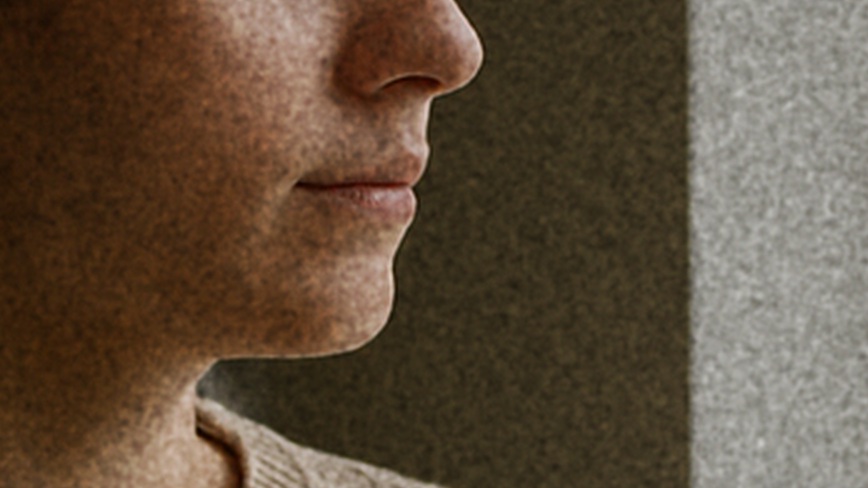
Grain Coarse 02
16mm-scale grain. Obvious, and meant to be. Measured sigma 12.00, grain radius 4.78 px, single channel, pure luminance. Both crops below are cut at this page's own width and never resized, so you are looking at the real pixels.
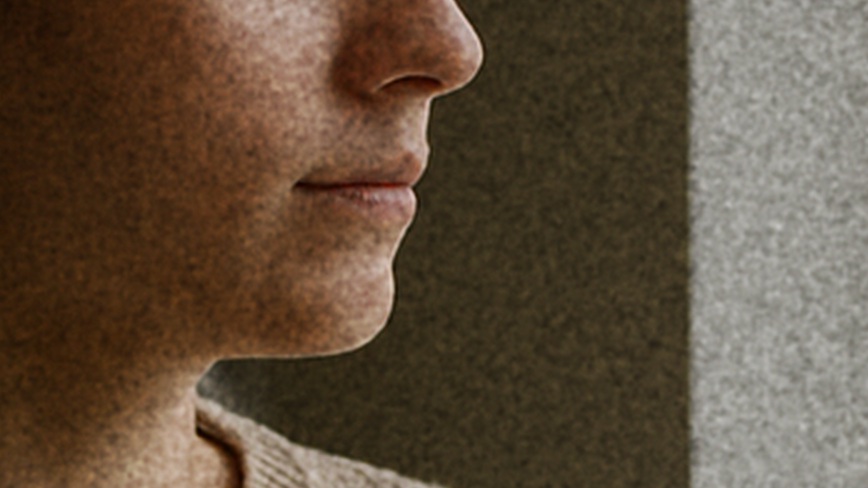
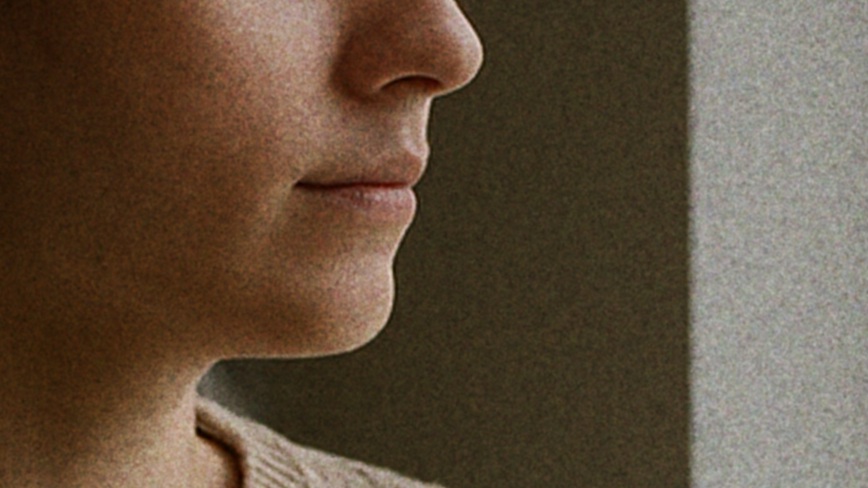
Grain Chroma Medium
Independent noise in each channel, so the grain carries colour. Reads as older colour stock, or as a camera pushed too far. Measured sigma 9.45, grain radius 2.49 px, inter-channel r 0.906, so the colour fluctuation rides on a shared luminance one. Both crops below are cut at this page's own width and never resized, so you are looking at the real pixels.
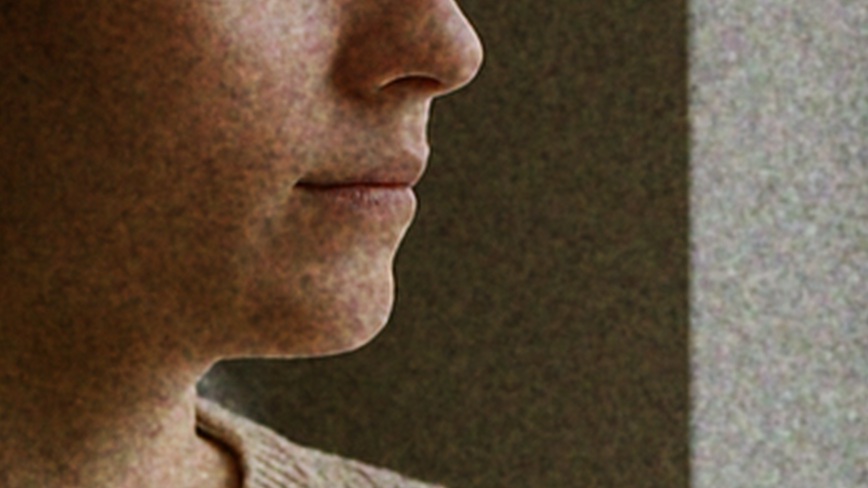
Grain Chroma Coarse
Independent noise in each channel, so the grain carries colour. Reads as older colour stock, or as a camera pushed too far. Measured sigma 11.55, grain radius 4.85 px, inter-channel r 0.906, so the colour fluctuation rides on a shared luminance one. Both crops below are cut at this page's own width and never resized, so you are looking at the real pixels.
Dust and scratches
Real alpha channels, so they composite at Normal. Every mark is pure white or pure black — never a muddy grey — and most of the frame is left completely untouched. Shown whole-frame and reduced.




Light leaks
Sums of anisotropic Gaussian fields on genuinely pure black, so Screen is an identity everywhere outside the leak. These are not photographs of real light leaks and are not presented as any. Shown whole-frame and reduced.




Vignettes
Pure black with a radial alpha ramp. Exactly transparent at the centre pixel, rising monotonically outward along every diagonal. Shown whole-frame and reduced.



Four grain fields out of every grain file
A grain plate is uncorrelated with its own mirror images. Worst measured correlation between a plate and its own horizontal flip, vertical flip or 180° rotation: 0.0040. So flipping gives you three more usable fields that will not read as the same texture.
8 grain files, 32 distinct grain fields. The two plates of each size are independent of each other too — worst measured correlation between a pair, 0.0038.
What was checked before this shipped
- Every plate 3840×2160 and 8-bit, in the colour mode its family requires — single-channel grey for monochrome grain, RGB for chromatic grain and leaks, RGBA for dust, scratches and vignettes.
- Grain zero-mean on code 128 to within 0.05, within 2% of the sigma it claims, and nothing clipped at 0 or 255 in any of the 8 plates — a clipped grain field is a truncated distribution and it shows in the darks.
- Grain size, measured. The autocorrelation radius is computed from the written pixels rather than read off the blur setting.
- The Overlay response curve itself, by compositing each plate over a grey ramp, quantising to 8 bits as a renderer would, and comparing the measured standard deviation against the prediction at seven levels.
- Dust and scratch plates mark 1.27% to 4.34% of the frame and leave the rest completely untouched, and every mark is pure white or pure black.
- Light leaks sit on at least 52% genuinely pure black, so Screen is an identity outside the leak, and each leak's measured brightness centroid really is where its name puts it.
- Vignettes are exactly transparent at the centre pixel, carry no colour of their own, and rise monotonically outward along every diagonal.
- 188 assertions, all passing, 157,593,600 pixels examined.
What they will not do
- The 19 plates are stills, and the moving grain is 1080p, not 4K. Real film grain changes every frame, so three grain families (fine, medium, coarse) also ship as one-second looping clips at 1920×1080. One second of 4K grain is about 43 MB, which is why they are not 4K; scaled onto a 4K timeline the grain looks twice as big, so use Fine where you would normally use Medium. A one-second loop can show on a long static shot — two copies offset in time, or one reversed, breaks the cadence.
- These have never been opened in Final Cut Pro. There is no Mac and no copy of Final Cut Pro on the machine they were built on. PNG is an ordinary still image format and these are valid 8-bit PNGs, which was checked — but "it imports and composites correctly in Final Cut Pro" was not testable here and is not claimed.
- Procedural, not photographed. Filtered Gaussian noise, Gaussian light fields, drawn specks and lines. Nothing is a scan of real film.
- Nothing in the pack is AI-generated. The demonstration photograph on this page is AI-generated and the person in it is not real. It is a test frame and it is not in the download.
- 4K plates on a 1080p timeline read one step finer, because the plate is being scaled to half size. Reach for Coarse where you would have used Medium.
- 19 plates, not 300. A small deliberate set. No support — one-time download, sold as-is.
Get it
Film Grain and Texture Overlays for Final Cut Pro — $8
19 PNG plates at 3840×2160 plus three moving grain loops at 1920×1080, about 80 MB. No plugin, no installer, no account. Works in any editor that imports a PNG and offers blend modes.